We were headed to St. Johns as the initial point of interest on our way home from Albuquerque. It did not take us but a minute to change our mind and head to the Petrified National Park instead. Interestingly, this park is actually a combination of two areas. The first is referred to as the Painted Desert and the second as The Petrified Forest. The park was doubled in size in 2004 and is described as a world class scientific laboratory for the end of the Triassic Period which occurred some 237 - 205 million years ago!
The park extends both north and south of I-40. We started on the north side where the main attractions are the Painted Desert and the Painted Desert Inn. There are ample pullouts if all you want to do is drive the 28 mile paved road that takes you from one end to the other of the park. This is the best time of year to visit the park. There were not too many visitors and the weather was perfect. This area can be very hot in the summer and too cold and very windy in the winter. There are also wonderful developed trails, many of them easy to moderate that will take you down into the badlands and amongst the petrified wood.
I believe this is Tiponi Point from the pullout.
If I remember correctly, this is Tawa Point in the Painted Desert part of the Park.
Chinde Point and Painted Desert Inn
The woman at the desk said, "The best way to shoot that skylight is to go down 5 steps, position your camera on the fourth step, contort yourself beyond recognition, pray you don't dump your camera in the process. Shoot quickly!" She was right. These are patters of famous Navajo rug patterns. No, I still have not managed to straighten my body back to normal shape so no laughter the next time you see me.
Sitting area at the Inn.
The Inn appears to have been maintained and restored very well.
The image below is of a stone pinhole camera. I wish I had copied down the information because doing more research on this camera has not been fruitful. It is a cast pinhole camera and to determine exposure time the photographer had to use a light meter and slide rule (both shown with the camera). The camera is encased and I spent 20 minutes to get this rather poor image of the camera. The point was made that because the images took so long to expose on 4X5 glass that everyone had time to tell stories and marvel at the landscape. The images were used to create postcards that were sold. If you go to the Inn be sure to check out this exhibit. Fascinating!!
Shot through glass. It appears that the front lever looking thingie is what was used as a cover to the pinhole. The camera was metal that had been cast in a ceramic mold.
Nizhoni Paint
Nizhoni Point
This old '32 Studebaker was used to denote where the historic route 66 crossed the Park at one time. Very close to the current I-40.
At this point we crossed over the I-40 and headed south to a bit more Painted Desert, an archeological restoration of the Puerco Pueblo, petroglyphs, Blue Mesa, and finally, some petrified rock. We chose not to go hiking as we were running late and passed on the Pueblo.
Rio Puerco. The cottonwoods were very vibrant all along the washes, creeks and rivers in the high deserts and Albuquerque.
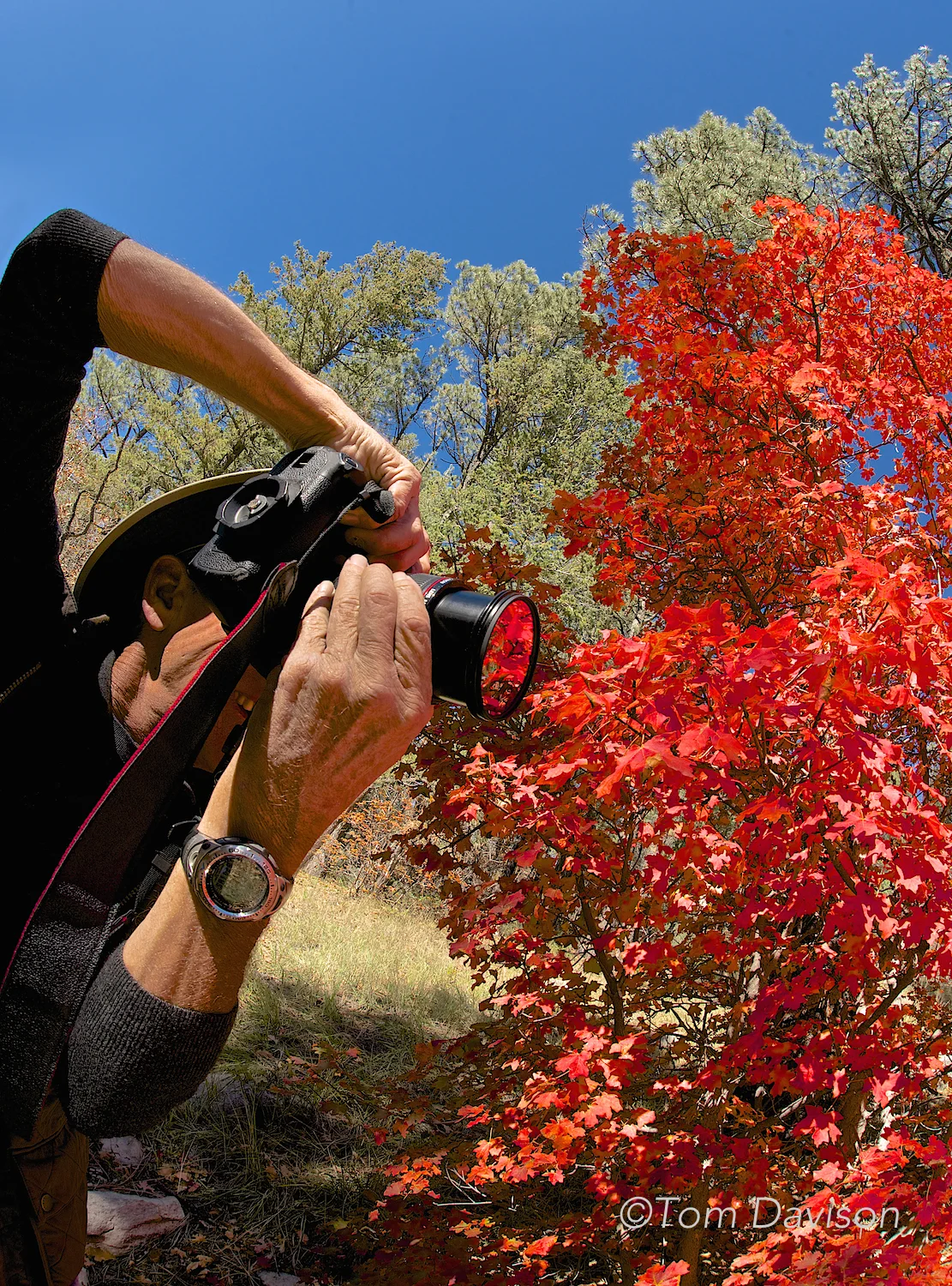
Can you tell that Tom really liked working this location?
Blue Mesa. There is a 3 mile loop trail along the bottom that, from what we could see, was paved!! I would love to take the trail next time and get photos looking up instead of down.
If you look carefully you may spot a part of the trail on the left side. It is hard to appreciate the scale in a photo like this. Sorry, no hikers to help me out!
We stopped at Newspaper Rock where we could see some of the hundreds of petroglyphs carved into stone.
We then went on to the part of the Park that shows petrified wood and the painted desert landscape became less important. That is the next blog entry. Stay with us.